
DESIGNVADMarc Vadurel
Senior Product Designer & Design Engineer
Design Engineering & Workflow Velocity.
Moving from static screens to real product validation.
As AI accelerates interface generation, the role of designers is evolving. Design is no longer only about producing screens. It is increasingly about reducing product uncertainty through rapid experimentation.
To support this shift, I developed a hybrid workflow that combines exploration, functional prototyping and AI-assisted analysis. The objective is simple: transform product ideas into testable experiences as quickly as possible and enable teams to learn faster.
Choosing the right strategy
Not all product challenges require the same design approach. Before starting a project, I use a triage framework to clarify the nature of the problem and select the appropriate strategy.
The Architect approach focuses on creating new products (0 → 1). When an idea is still vague, the goal is to transform it into a viable product direction by defining the value proposition, the target user and the smallest viable product.
The Auditor approach focuses on improving existing products (1 → 10). Through UX audits, analytics and usability testing, the objective is to identify friction points and prioritize improvements that can deliver measurable impact.
The Miner approach focuses on exploration and discovery. Through qualitative research and opportunity mapping, it helps uncover unmet user needs and identify new product opportunities before investing in development.
From screens to real interactions
Traditional prototypes validate layout and navigation, but they rarely simulate how a real product behaves.
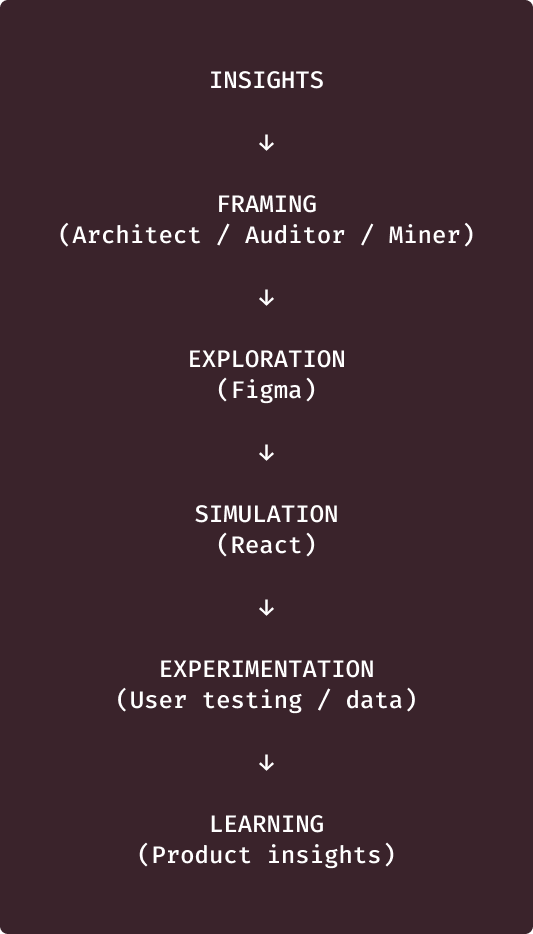
To test ideas more realistically, I combine Figma exploration with React prototyping. Figma allows rapid exploration and iteration, while React prototypes simulate real interactions such as navigation logic, dynamic states and interaction feedback.
This approach makes it possible to test not only what an interface looks like, but how the system behaves. As a result, user testing becomes more reliable and design decisions can be validated earlier.
Accelerating research and synthesis
AI can significantly accelerate the early stages of product design, especially research synthesis and problem framing.
To support this, I developed a set of specialized AI agents that assist different phases of the process. Some agents help analyze project briefs and identify the nature of the problem, while others synthesize research insights or transform audits into prioritized opportunities.
These tools do not replace design thinking. They act as accelerators that reduce the time spent on analysis and allow designers to focus on experimentation and product learning.
Design as experimentation
Modern product teams operate in environments where uncertainty is high and continuous experimentation is essential.
Instead of following a strictly linear process, my workflow relies on a learning loop where insights lead to hypotheses, prototypes and experiments. Each experiment generates learning that informs the next iteration.
By combining human insight, functional prototyping and rapid experimentation, design becomes a driver of product learning rather than simply a production step.


Design Engineering & AI Workflow
Commercial Real Estate Platform
Design System

E-commerce

Real Estate Platform

Kids Website
Business application
Crowdfunding platform
E-magazine
Digital banking platform

Brand website

Government portal
Web documentary

Brand website

E-commerce

Event website

Client Logo Projects

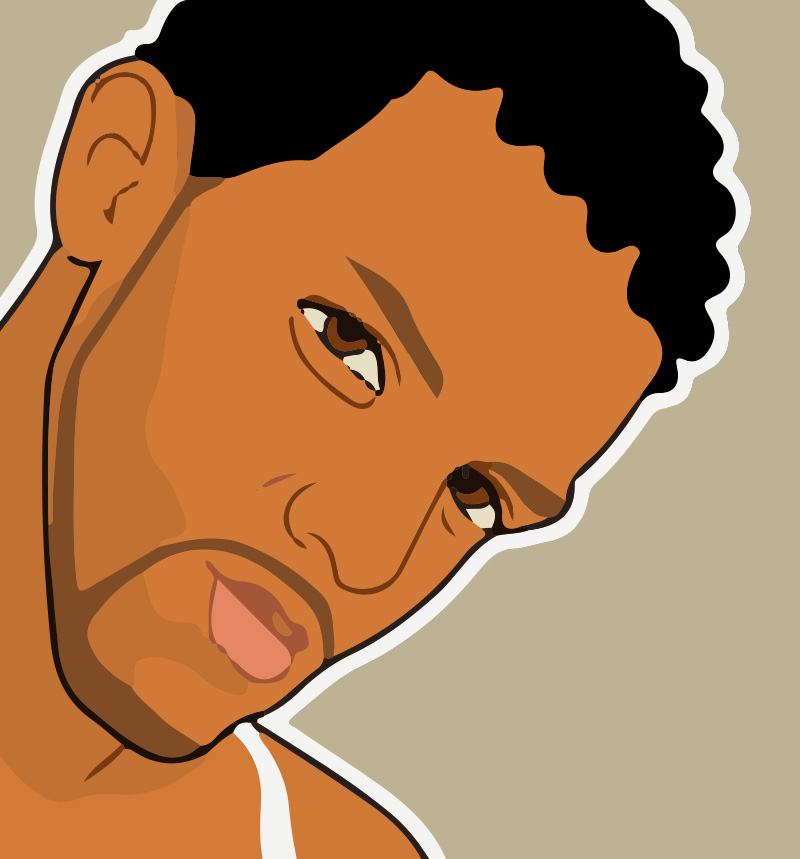
Illustrations